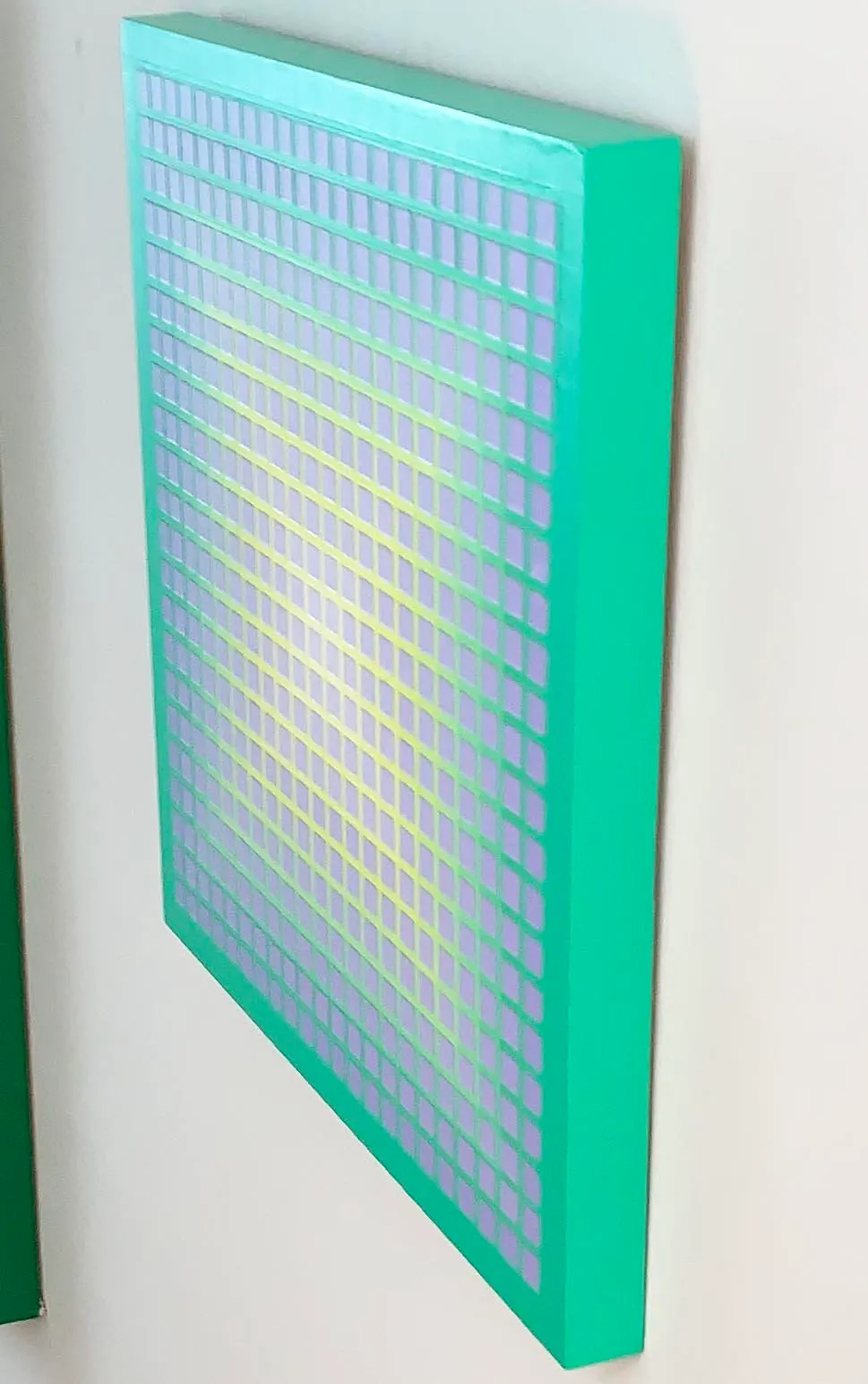
This is an original acrylic on panel painting entitled “Geometric Glow Asterism” (created December 28 2019). It measures 12″ X 12″ and is part of my “Asterism Series” of contemporary op artworks. The term “asterism” refers to the “X” that appears to the eye — but does not exist in the painting — and occurs when contiguous colors interact from light to dark or dark to light. I am influenced by the Op Artists of the 1960s and 1970s — especially Julian Stanczak, Carlos Cruz Diez, and Richard Anuszkiewicz. I have finished all four sides, so there’s no need for a frame.
About My Asterism Series of Original Abstract Paintings
Why does that “X” appear in my Asterism paintings? This visual deception is an example of simultaneous contrast in original abstract painting.
Simultaneous contrast, or the contrast effect, is a visual phenomenon where the perception of one color is affected by the presence of surrounding colors. Specifically, the brightness, saturation, and even the hue of a color can be altered by the colors surrounding it.
There are two types of simultaneous contrast: successive contrast and simultaneous contrast. Successive contrast occurs when the perception of a color is affected by the colors that came before it. Simultaneous contrast occurs when the perception of a color is affected by its surrounding colors and is especially noticeable in this original abstract painting.
The simultaneous contrast effect is powerful when the adjacent colors are complementary, meaning they are opposite on the color wheel. For example, red and green are complementary colors, as are blue and orange, and yellow and purple. When complementary colors are placed next to each other, they can create a strong contrast effect, with each color appearing more vibrant and intense.
In addition to complementary colors, the simultaneous contrast effect can also occur between colors that are not complementary but are simply different in brightness or saturation. For example, a medium gray color may appear darker when placed next to a white color, and lighter when placed next to a black color.
I enjoy exploring how subtle color changes can create illusions such as Asterisms or a sense of glowing or depth, particularly in original abstract painting.